


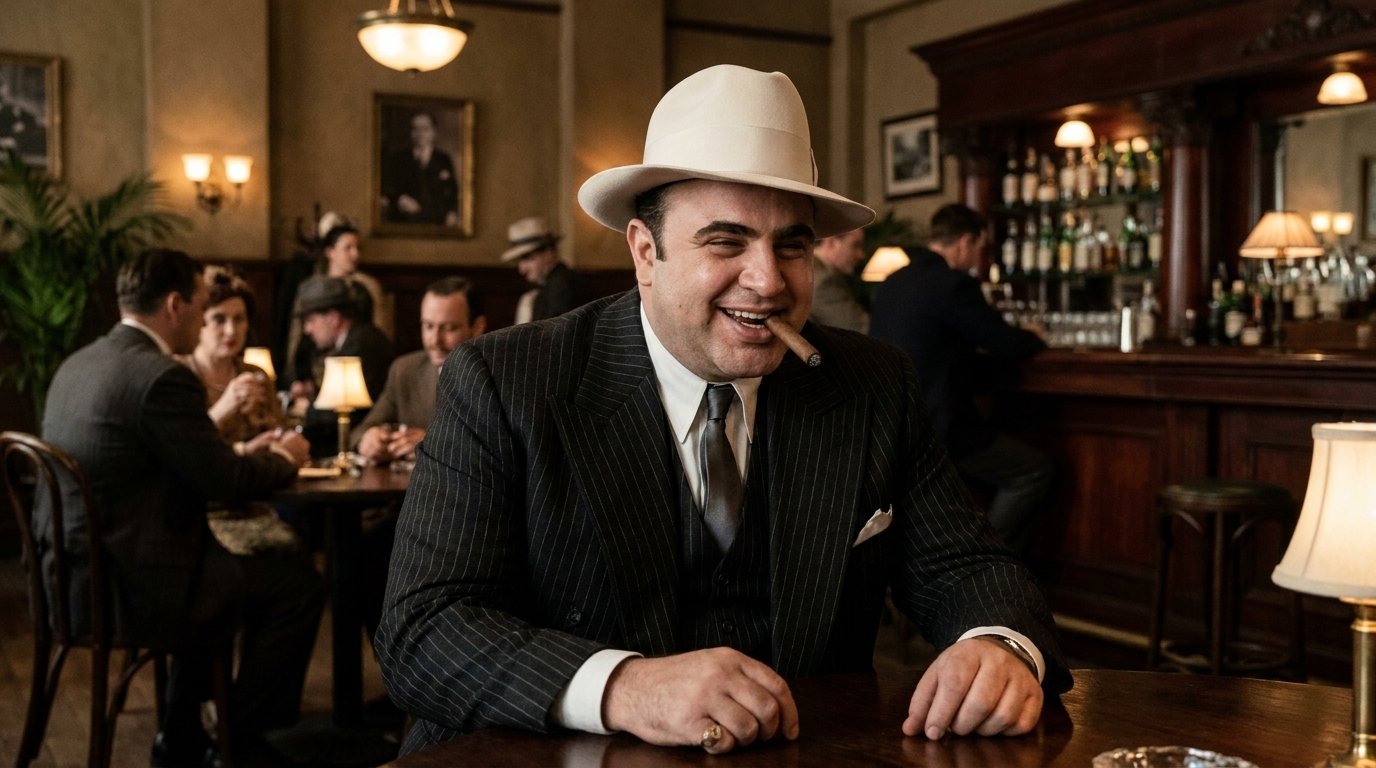
Al Capone remains one of the most recognizable names in American crime history, nearly eighty years after his death. He built one of the most powerful criminal organizations of the Prohibition era, combining an organized business structure with violence and intimidation while becoming a national symbol of organized crime. His rise eventually ended with a federal tax-evasion conviction and imprisonment at Alcatraz, the famous island prison that later became one of America’s best-known historic landmarks.
In 2026, Capone’s name has once again appeared in public discussion because of renewed debate over the future of Alcatraz. His connection to the prison has brought fresh attention to his life and criminal career decades after his death. This biography looks at Al Capone’s childhood, his rise in Chicago, the criminal empire he controlled, his downfall, his years in prison, his declining health, and the legacy that continues to keep his name familiar today.
Quick Facts
| Category | Detail |
|---|---|
| Full Name | Alphonse Gabriel Capone |
| Born | January 17, 1899, Brooklyn, New York |
| Died | January 25, 1947, Palm Island, Miami Beach, Florida, at age 48 |
| Known As | “Scarface,” Public Enemy No. 1 |
| Occupation | Organized crime boss, leader of the Chicago Outfit |
| Years Active | Roughly 1919 to 1931 |
| Spouse | Mae Josephine Coughlin, married in 1918 |
| Children | Albert “Sonny” Capone |
| Cause of Death | Cardiac arrest following complications associated with untreated syphilis |
| Estimated Fortune | Around $100 million at his peak, unadjusted for inflation |
Who Was Al Capone?
Alphonse Gabriel Capone was born on January 17, 1899, in Brooklyn, New York, and was the fourth of nine children born to Gabriele and Teresina Capone, Italian immigrants who had come to the United States from Naples. His father worked as a barber, while his mother earned money through sewing, and the family was generally described as a hardworking immigrant household rather than one already connected to organized crime. Capone grew up near the Brooklyn Navy Yard in a neighborhood filled with bars, dockworkers, and street gangs, and that environment gradually exposed him to the criminal world that would eventually define his life.
Capone struggled academically and repeated the sixth grade before leaving school permanently at around fourteen years old following a physical confrontation with a teacher. After leaving school, he became increasingly involved with Brooklyn street gangs, including groups such as the Junior Forty Thieves and later the Five Points Gang, one of New York’s better-known criminal organizations. During this period, he came into contact with Johnny Torrio, an experienced gangster who would become an important influence on his career, as well as Charles “Lucky” Luciano, who later became another major figure in American organized crime.
Capone also worked as a bouncer at a Brooklyn saloon connected to Torrio’s criminal circle. It was during these years that he received the facial scars that led to his famous nickname, “Scarface.” According to widely repeated accounts, a man named Frank Galluccio slashed Capone’s face with a knife after Capone made a comment to Galluccio’s sister. The attack left three noticeable scars on his face, although Capone reportedly disliked the nickname and did not like people using it around him.

Moving to Chicago and Building a Crime Empire
By 1919, Capone had attracted the attention of New York police, who suspected him in connection with at least two killings. Around that time, Johnny Torrio invited him to Chicago to help with criminal operations connected to Torrio’s organization. The arrival of Prohibition in 1920 created an enormous illegal market for alcohol, and Torrio and Capone recognized that bootlegging could generate huge amounts of money. Their organization developed a network of breweries, speakeasies, distribution routes, gambling operations, and other illegal businesses throughout the Chicago area.
Torrio remained the more senior figure until 1925, when he was seriously wounded during an assassination attempt and eventually retired from the business. Capone then took control of the criminal organization that became known as the Chicago Outfit. Under his leadership, the operation expanded beyond bootlegging into gambling, prostitution, protection rackets, and other illegal activities while fighting rival organizations for control of Chicago’s criminal underworld.
Capone developed a complicated public image during these years. He was widely associated with violence and organized crime, yet he also tried to present himself as a businessman and community figure. During the Great Depression, he became known for supporting charitable efforts such as soup kitchens, which contributed to a surprising level of popularity among some members of Chicago’s working-class population. At the same time, law-enforcement agencies continued trying to connect him directly to the violence carried out by his organization.
The most infamous event associated with Capone’s criminal empire occurred on February 14, 1929, when seven members and associates of a rival gang were killed in what became known as the St. Valentine’s Day Massacre. The attackers reportedly posed as police officers before opening fire on the victims. The killings were widely believed to have been connected to Capone’s organization, although Capone was never formally charged or convicted for ordering the massacre.
The Fall: Tax Evasion and Prison
Federal investigators spent years trying to build successful criminal cases against Capone for the violence and illegal businesses connected to his organization, but obtaining convictions for those crimes proved difficult. Authorities eventually found a more effective way to prosecute him by focusing on his finances. Investigators demonstrated that Capone had earned large amounts of money from illegal activities while failing to properly report that income to the federal government.
In 1931, Capone was convicted of federal income-tax evasion and sentenced to eleven years in prison. The conviction effectively ended his active career as one of America’s most powerful organized-crime figures. Although the charges were far less dramatic than the murders, gang wars, and other crimes commonly associated with his organization, the tax case accomplished what years of other investigations had failed to do by removing him from the criminal empire he had built.
Capone began serving his sentence at the federal penitentiary in Atlanta in 1932. Two years later, in 1934, he was transferred to the newly opened federal prison on Alcatraz Island in San Francisco Bay. The facility was designed to hold particularly difficult and high-profile federal prisoners, and Capone became one of its most famous inmates. At Alcatraz, he was identified as Inmate No. 85 and had far less ability to communicate with associates or influence criminal operations outside the prison.
Life at Alcatraz was very different from the influence Capone had once enjoyed in Chicago. He reportedly worked in the prison laundry and spent some of his free time playing the banjo as part of the prison’s musical activities. More importantly, his physical and mental health began deteriorating significantly during his imprisonment. Capone had contracted syphilis when he was younger, and because the disease had gone untreated for years, it eventually developed into neurosyphilis, a serious late-stage condition that affects the brain and nervous system.
By the second half of the 1930s, Capone was reportedly experiencing confusion, memory problems, and major changes in his behavior and mental state. Doctors diagnosed him with syphilis of the brain in 1938, and his condition became serious enough that he spent much of his final period at Alcatraz receiving medical care rather than remaining with the prison’s general population.
Release and Final Years
Capone was released from federal custody on November 16, 1939, after serving approximately seven and a half years of his sentence, including credit for good behavior. By the time he left prison, however, the man who had once controlled a major criminal organization was no longer capable of returning to his former position. His influence within organized crime had largely disappeared, his health had deteriorated badly, and reports from the period indicated that his financial position was also much weaker than it had been during the height of his career.
After his release, Capone received medical treatment at a hospital in Baltimore before returning to his estate on Palm Island in Miami Beach, Florida. He spent the remainder of his life there with his wife, Mae, and other members of his family while his physical and mental condition continued to decline. In January 1947, Capone suffered a stroke, and his health worsened further in the following days.
Al Capone died on January 25, 1947, at the age of 48, only eight days after his birthday. Cardiac arrest and pneumonia were associated with his death, while the long-term effects of advanced untreated syphilis had already caused serious neurological damage. Contemporary reports suggested that his cognitive abilities had declined dramatically by the final years of his life, making his quiet death in Florida very different from the powerful and highly publicized life he had lived during Chicago’s Prohibition era.
Why Al Capone Is Back in the News in 2026
Although Capone has been dead for nearly eight decades, his famous connection to Alcatraz has made his name relevant to a current political debate. In May 2025, President Donald Trump said he was directing the Federal Bureau of Prisons and other federal agencies to rebuild and reopen Alcatraz as a substantially expanded prison for dangerous offenders. The former federal penitentiary had closed in 1963 and later became a historic site and major tourist attraction operated as part of the National Park Service system.
The proposal moved beyond the original announcement in 2026 when the Trump administration’s fiscal year 2027 budget requested $152 million for Alcatraz reactivation planning and initial work. Department of Justice budget documents say the requested money would support an environmental impact statement, site mobilization, preparatory work, logistics, and part of the seismic stabilization needed for a possible return to prison use. The broader cost and timeline remain uncertain, and the proposal has drawn opposition from political leaders in California, including former House Speaker Nancy Pelosi and other state and local officials.
Because Capone remains one of the most famous people ever imprisoned at Alcatraz, his name continues to appear whenever the island’s history and possible future are discussed. The modern debate has therefore renewed interest in his years at the prison and introduced his story to another generation of readers.
Legacy
Al Capone’s life has been retold through books, documentaries, television programs, and films for decades, making it increasingly difficult to separate the documented historical figure from the larger pop-culture legend built around his name. His story has become closely associated with Prohibition, Chicago gang warfare, bootlegging, and the growth of organized crime in early twentieth-century America. Because so many stories about him have been repeated over the years, some widely circulated claims about his wealth, personal life, and criminal activities remain difficult to verify with complete certainty.
What remains clear is that Capone became one of the strongest symbols of how profitable and highly organized criminal businesses could become during Prohibition. His downfall is equally significant because federal authorities ultimately removed him from power through a financial prosecution rather than securing a conviction for the violent crimes associated with his organization. His years at Alcatraz, his declining health, and his early death added another chapter to a story that continues to attract public interest long after the criminal empire itself disappeared. Readers interested in another NTX Magazine profile connected to American organized-crime history can also read Deborah Merlino: Joey Merlino’s Wife, Family & Career.
How This Was Researched
This biography was prepared using established historical records, encyclopedic information, archival material, and current reporting about the 2025 and 2026 debate surrounding Alcatraz. Where commonly repeated claims remain uncertain, especially estimates of Capone’s personal fortune, those figures are treated as estimates rather than unquestioned facts.
Many biographies of Capone concentrate heavily on his Chicago years while giving less attention to the serious health problems that affected him during his imprisonment and after his release. This profile also includes the renewed 2026 discussion surrounding Alcatraz because that developing story helps explain why Capone’s name and his years at the prison have received fresh public attention.
Accuracy Note
This biography is based on publicly available historical records and current information available in 2026. Some details, particularly estimates surrounding Al Capone’s wealth and certain stories repeated about his criminal career, vary depending on the historical account and should be understood as estimates or reported claims rather than completely documented facts. If updated or more reliable information becomes available, the article can be reviewed and corrected.
Written and researched by Hassan, contributor at NTX Magazine.
FAQ
When was Al Capone born, and when did he die?
Al Capone was born on January 17, 1899, in Brooklyn, New York. He died on January 25, 1947, in Miami Beach, Florida, at the age of 48 after suffering serious health problems during the final years of his life.
Why was Al Capone finally sent to prison?
Federal investigators struggled to secure convictions against Capone for the violent crimes associated with his organization, so prosecutors eventually focused on his finances. He was convicted of federal income-tax evasion in 1931 after investigators showed that he had failed to properly report income earned through his activities.
Did Al Capone spend time at Alcatraz?
Yes. Capone was transferred to Alcatraz in 1934 after first serving part of his federal prison sentence in Atlanta. He remained at Alcatraz for several years, and his physical and mental health deteriorated significantly during that period because of complications from untreated syphilis.
What did Al Capone die of?
Capone died after suffering serious medical problems that included a stroke, pneumonia, and cardiac arrest. His long-term health had already been severely affected by advanced untreated syphilis, which had progressed to neurosyphilis and caused neurological damage.
Why is Al Capone in the news again in 2026?
Capone’s name has returned to public discussion because of proposals to reactivate Alcatraz as a federal prison. The Trump administration requested $152 million in its fiscal year 2027 budget for initial Alcatraz reactivation work, renewing public attention on the prison and famous former inmates such as Capone.

Written by Hassan, founder and editor of NTX Magazine — an independent news and biography publication. Every article is researched and cross-checked against multiple public sources before publishing; see our Sourcing Standards page for details.
